Wednesday, May 28, 2014

Religious Leaders Ask Wendy's to Join the Fair Food Program

Mr.EmilBrolick,
CEO Wendy’sInternational,Inc.
1 DaveThomasBlvd.
Dublin, OH, 43017
May 23, 2014

Dear Mr.Brolick:

Nine years ago, as the CEO of Taco Bell, you pioneered a partnership with the Coalition of Immokalee
Workers and Florida growers that set in motion a new paradigm for human rights and corporate responsibility. For three years, the Fair Food Program has been in operation in over ninety percent of
Florida’s 650 million dollar industry and the changes have been as comprehensive as they are
breathtaking.

While for generations the Florida tomato industry was plagued by poverty wages, wage theft, sexual
harassment and, in extreme cases, forced labor, those abuses are now not only being eliminated, their
root causes are being addressed through the Fair Food Program (FFP).  The  Program has been lauded
by the UN Working Group on Business and Human Rights and the White House for its innovation,
impact and sustainability, and has gained global recognition as the new paradigm for corporate
social responsibility.

Twelve corporations have joined the Fair Food Program, agreeing to pay a penny-­‐per-­‐pound premium
to their Florida tomato suppliers that is passed on to workers through the growers’ regular payroll process,
and to purchase only from growers that uphold the Fair Food Code of Conduct.  The largest global
retailer, Wal-­‐Mart, joined in January of this year and four out of five of our nation’s leading fast-­‐food
restaurants are already participating.  But not Wendy’s.  Instead Wendy’s has tried to give consumers
the impression that it supports the changes achieved through the FFP while in fact continuing to do
business as usual.

By refusing to join its competitors in paying the penny-­‐per-­‐pound premium, Wendy’s gains
an unconscionable cost advantage over the rest of the fast-­‐food industry leaders.

By refusing to commit to buy its Florida tomatoes only from growers complying with the Fair Food
Program, Wendy’s perpetuates the old, “no questions asked” market for those growers unwilling to
recognize the FFP’s human rights standards.

We are perplexed and alarmed at Wendy’s posture on this issue of basic human rights. The call for
society to recognize that our lives are intertwined, that our decisions and actions impact one another,
and that we have a moral responsibility to ensure human well-­‐being is as ancient as the command,
“love thy neighbor.”

The time is now to answer that call.  Perfect what you pioneered nine years ago.  Lead Wendy’s
to be part of the common good we are building together as consumers, farmworkers, growers and
buyers by joining the Fair Food Program.
Sincerely,


Jim Winkler, General Secretary and President, National Council of Churches, USA

Gradye Parsons, Stated Clerk, Office of the General Assembly, Presbyterian Church (U.S.A.)

Linda Valentine, Executive Director, Presbyterian Mission Agency, Presbyterian Church (U.S.A.)

Rev. Geoffrey A. Black, General Minister and President, United Church of Christ

Rev. Dr. Sharon E. Watkins, General Minister and President, Christian Church (Disciples of Christ)

Rev. Dr. Susan Henry-Crowe, The United Methodist Church - General Board of Church and Society

Harriett Jane Olson, General Secretary and CEO, United Methodist Women

Ervin R. Stutzman, Executive Director, Mennonite Church USA

Rabbi Jill Jacobs, Executive Director, T’ruah: The Rabbinic Call for Human Rights

Dr. Sayyid M. Syeed, National Director of Interfaith & Community Alliances, Islamic Society of North America

Brian D. McLaren, author, speaker, blogger

Shane Claiborne, author, activist, founder of The Simple Way

Sr. Patricia Chappell, SNDdeN, Executive Director, Pax Christi USA

Kim Bobo, Executive Director, Interfaith Worker Justice

Rev. Lindsay C. Comstock, Executive Director, National Farm Worker Ministry

Nico Gumbs, Youth and Young Adult Network of the National Farm Worker Ministry

James Ennis, Executive Director, Catholic Rural Life

Dianne Aid, TSSF, President, Episcopal Network for Economic Justice

Bishop Chuck Leigh, Ecumenical Catholic Communion 

Sisters of Charity of the Blessed Virgin Mary, Dubuque, Iowa

Rev. Dr. Liz Theoharis, Co-Director, Kairos Center for Religions, Rights, and Social Justice and Coordinator, Poverty Initiative, Union Theological Seminary

Rabbi Joshua Lesser, Chair of the Social Justice Commission of the Jewish Reconstructionist Commissioners

,

Thursday, May 15, 2014

Presbyterian Eco-Stewards to Learn About Florida Farm Workers and Fair Food May 19, 2014.

Eco-Stewards, a group of young adults studying creation care issues, will visit Westminster Presbyterian Church, 1525 NW 34th Street, Gainesville FL at 4 p.m. on Monday May 19 for a program about Florida farm workers and their efforts to secure just wages and decent working conditions for themselves.  They will participate in a conference call via Skype with the Coalition of Immokalee Workers and hear from Dr. Sam Trickey about the work of National Farm Worker Ministry.  Gainesville's Interfaith Alliance for Immigrant Justice will also have a presentation on what we've been doing locally.

Saturday, February 1, 2014


Spring action announced!: The “Now is the Time” Tour hits the road March 5-15, 2014…


Share Button

publix_vigil4Ten-day, ten-city tour to take farmworkers, allies to Wendy’s home state of Ohio, then back to Florida with a last stop in Publix’s hometown of Lakeland…

Stops along the way to include actions in major cities, including Atlanta, GA, Raleigh, NC, Louisville, KY and Nashville, TN!

During his speech at the March on Washington 50 years ago last August, Dr. Martin Luther King shared the following words with the nation — a nation on the brink of turmoil due to the stubborn, centuries-long denial of African Americans’ civil and economic rights by a shrinking circle of hardcore segregationists — to underscore what he called “the fierce urgency of now”:
“Now is the time to rise from the dark and desolate valley of segregation to the sunlit path of racial justice.”
The “now” to which Dr. King referred was a crucial moment in the decades-long history of the Civil Rights Movement.  There had been several victories in the years preceding the March on Washington — including the Supreme Court decision in Brown v. Board of Education of Topeka, Kans., declaring segregation in public schools unconstitutional and paving the way for large-scale desegregation, and the Montgomery Bus Boycott, desegregating the bus system in Montgomery, AL, through community action — but it was still early in the movement, and a long road of struggle remained to be traveled for the victories to take root.

The fierce urgency of now… today

Today, fifty years later, farmworkers find themselves in a similarly crucial moment in their two-decade-old struggle for human rights and dignity.  Since launching the Campaign for Fair Food in 2001 with the Taco Bell Boycott, workers from Immokalee and their allies across the country have seen twelve major victories, from the seminal Fair Food agreement with Taco Bell in 2005 to the agreement with Walmart just last week.  And three years ago, the Campaign for Fair Food brought the Florida Tomato Growers Exchange and over 90% of the Florida tomato industry on board, making possible the 2011 launch of the Fair Food Program.  In the three short years since that landmark agreement, the Fair Food Standards Council has overseen the implementation of the Fair Food Program in Florida’s tomato fields, and the changes – identifying and eliminating the bad actors and bad practices that plagued Florida’s fields for decades, and establishing new practices and policies that promote a safer, more humane workplace – have been nothing short of astonishing.
2013iThose results have been achieved through a combination of worker-to-worker education, an effective complaint investigation and resolution process, regular field and farm office audits, market consequences for violations of the Fair Food Code of Conduct, and the penny-per-pound premium.  The approach is based on two key principles:
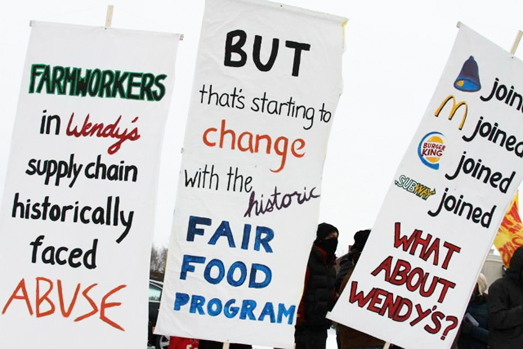
1) When it comes to protecting human rights in corporate supply chains, the humans whose rights are in question must be the principal architects of the effort, and;
2) Market consequences are the only incentive powerful enough to ensure consistent compliance with human rights standards.
The FFP’s worker-led, market-driven approach is unique in the world of social accountability, and its success has been noted by observers from the White House to the United Nations.
But though the New Day of respect for fundamental human rights has indeed dawned in Florida’s fields, there remains a great deal more to be done before we can truly walk the “sunlit path of justice” of Dr. King’s vision.

Publix, Wendy’s obstruct the path…

In the wake of the Walmart agreement earlier this month — a watershed moment in the Fair Food movement, signaling the consolidation of the Fair Food Program in the Florida tomato industry and the expansion of its innovative model beyond Florida and to crops other than tomatoes — the editorial board of the Tampa Bay Times (one of Publix’s two hometown papers) wrote:
With Whole Foods, Trader Joe’s and Wal-Mart now participating in the program, there is no reason Publix should not join its grocery competitors in helping to raise pay and improve working conditions in Florida’s tomato fields. The Coalition of Immokalee Workers has demonstrated that determination, organization and public outreach can make a real difference in improving the lives of workers who are performing backbreaking work to feed America. Adding Wal-Mart to the effort will pay huge dividends, but there is more work to do… read more
That “more work” to which the Times’ editorial refers is the need to win still more support for the Program from the retail food giants, from companies like Publix and Wendy’s that refuse to step up to the new industry standards for human rights protection in their supply chains.
Wendys_Flagship_old_7
The Fair Food Program’s impact on workers’ lives is a direct function of the number of buyers participating in the Program.  Through the penny-per-pound premium that goes to improve wages, more buyers means a larger Fair Food bonus on workers’  paychecks.  And through the participating buyers’  commitment to purchase Florida tomatoes only from growers that comply with the Fair Food Code of Conduct, more buyers means greater support for the participating growers that meet the human rights standards set out in the Code.  And so every day that Publix and Wendy’s refuse to join, the  Fair Food Program is unable to realize its full potential, and farmworkers’ poverty is prolonged. 
Wendys_Flagship_old_2In 2001, we launched the Campaign for Fair Food with a simple slogan:  Taco Bell makes farmworkers poor.  But today, Publix and Wendy’s are keeping farmworkers poor through their unconscionable refusal to join their competitors in support of the Fair Food Program.  
What’s worse: Today, with their primary competitors supporting the penny-per-pound premium, both Wendy’s and Publix are actively profiting from their refusal to join the Program, wringing a small cost advantage over their competitors out of the meager wages of farmworkers who pick their tomatoes.  
Now is the time for this indefensible exploitation to end.  Now is the time for Publix and Wendy’s to abandon the road that leads back to the day when farmworkers were invisible and the hollow claims of corporate-led social responsibility went unchallenged.  Now is the time for Publix and Wendy’s to join the Fair Food Nation — farmworkers, consumers, growers, and their competitors — on the road to real social responsibility, respect for farmworkers as human beings, and a 21st century food industry where human rights are not only protected, but valued, the road to the New Day.

And so, we go on the road again…

In March, 2002, we hit the road for the first time in the Taco Bell Truth Tour.  This year, twelve years and twelve Fair Food agreements later, we are going on the road again on the “Now is the Time” Tour, calling on Publix and Wendy’s to join the Fair Food Program.  The Tour will cover ten cities in ten days and will take us from Florida to Ohio and back again, with actions in major cities along the route.   
Now_is_the_time

Thursday, December 5, 2013

Fair Food Means Fair Wages


IAIJ joins the protest at McDonald's restaurant at NE University Avenue and Waldo Road in Gainesville on Thursday December 5 as part of a nationwide demand by fast-food workers to be paid a living wage.

Friday, November 29, 2013

Calling on Wendy's to Support Fair Food


A delegation from Interfaith Alliance for Immigrant Justice visited Wendy's at 3611 SW Archer Road in Gainesville on Sunday afternoon December 1 to ask the local manager to remind corporate leadership that consumers want Wendy's to join the other fast-food tomato buyers who have signed the Fair Food Agreement providing farm workers with a living wage and decent working conditions.

Friday, October 18, 2013

"Breaking Bread, Building Bridges" October 29.

Gainesville's Interfaith Alliance for Immigrant Justice and Westminster Presbyterian Church will work together to introduce a new program to encourage dialogue about immigration issues in local faith communities.  Church members and student activists from IAIJ and CHISPAS will share their stories and talk about the pressing human need for comprehensive immigration reform.

The supper will begin at 6:30 p.m. Tuesday October 29 in the Community Building of Westminster Presbyterian Church, 1525 NW 34th Street, Gainesville, Florida.

Everyone is invited – please bring a dish to share. There will be a discussion on immigrant issues and sharing how our families immigrated to this country. Please contact the Westminster Church Office at 352-378-4032 or email gail.acree@wpcgainesville.org if you will be attending.

We hope this pilot project will be taken up by other faith communities in Gainesville and Alachua County.
Alachua County Migrants Share Their Stories in New Documentary Film First Screened October 1

"Siempre Adelante" a documentary film about recent immigrants in Alachua County, Florida had its world premiere at Pugh Hall on the University of Florida campus October 1.  Rev. Jaime Zelaya had the idea for a film that could be used in faith communities and other settings to help local residents better understand their new neighbors.  The Samuel Proctor Oral History Program at UF helped him bring the project to completion.
"Siempre Adelante" will be available for screening as copies were made for all IAIJ congregations.